
Learn about things that break the fast in Islam with clear Quran and Hadith references. Understand what invalidates fasting and what does not.
Introduction
Ramadan is a month of mercy, forgiveness, and blessings. You starve yourself every day, starting in the morning till the afternoon, to delight Allah and be nearer to Him. However, once in a while, a little suspicion creeps into your mind. You can say to yourself, did that break my fast. This is the question that bothers several Muslims during Ramadan.
Breaking the fast is a major issue that every Muslim ought to have a clear understanding of. When you are aware of the things that nullify fasting, then you save your worship and prevent all the needless terror. Simple, ordinary behaviour is puzzling to many. They believe that they are breaking their fast when not. Some might not know that some of their actions can make their fast null.
Not eating and not to drink is not all associated with fasting. It is a submission and self-discipline. This is the reason why it is so important to learn the correct rulings. Knowing things that do not abide by the fast, you can fast confidently, peacefully, and clearly.
You will find in this article clear and authentic guidance that is founded on the Quran and the Hadith of the Prophet Muhammad ﷺ. I will discuss all in easy and simple words so that you will not be confused. At the end, you will be confident in your fast, and you will be sure that you are going to finish Ramadan in the right manner.
Read also Which Dua to Read in Ramadan?
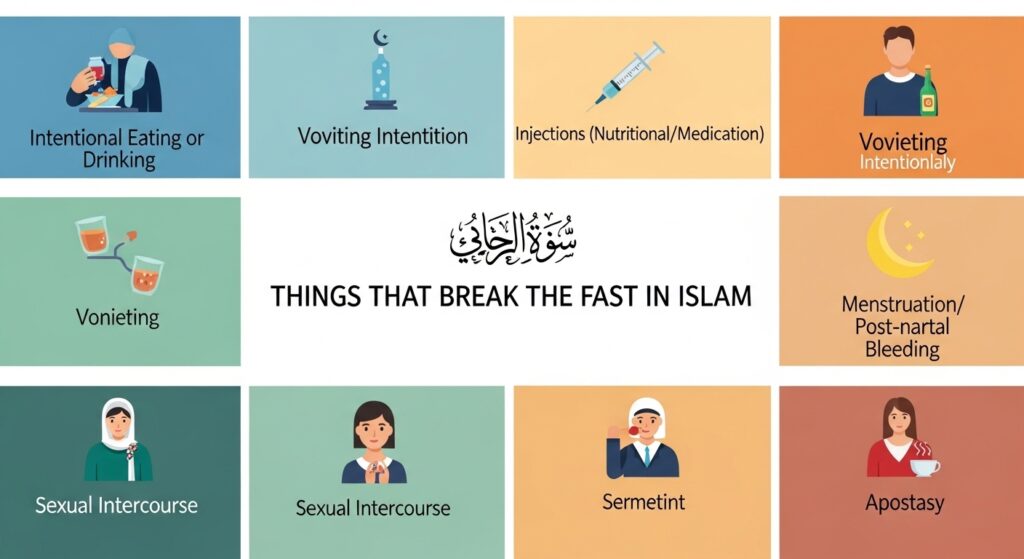
What Does It Mean to Break the Fast?
You must know what it actually means to break the fast before we discuss the detailed rulings. In Islam, fasting refers to the act of not eating, drinking, or performing any activity between dawn and sunset in the name of Allah.
You intend in thy heart, yea, and thou fastest with thy heart. This worship is referred to as Sawm. By that, we say things break the fast because we are referring to things that render the fast ineffective. When an individual commits such acts when he or she is on fasting time, then the fast is not considered.
In other instances, the individual has to compensate for the fast afterwards. In extreme cases, one is also expected to repay kaffarah. Nevertheless, one should know something or other. Not all the errors are obliterating the fast.
Some activities diminish the reward of fasting, but they do not cancel it. To give an example, the use of bad language, lying, or arguing will be detrimental to the reward. And these proceedings do not overrule the fast. Islam is a balanced and merciful religion. In case a person forgets and consumes or drinks, the fast will not be broken. In case a person commits a sincere error, Allah is Most Merciful.
Things That Break the Fast
Now we shall clearly see the principal things that break the fast. These are decisions provided by the Quran and the true Hadith. In case a person engages in such acts with the intention in the process of fasting, such a fast is invalid.
1. Intentionally Eating and Drinking.
Intentionally breaking your fast by eating or drinking is a sin. It is nullified by a mere drop of food or water. But when you unintentionally eat and drink, and forget about the fasting, your fast does not lose its validity. On remembering, at once stop, and proceed with your fast. Allah is the Most Merciful God who does not reward honest mistakes.
2. Marital Relations during Fasting Hours.
When a husband and wife engage in marital relations during Ramadan, he or she breaks the fast. This is a serious violation. In this instance, the individual will have to compensate for the fast afterwards. Also, Islam demands kaffarah, meaning to fast sixty days in a row or to feed sixty paupers in case of inability to do so.
3. Intentional Vomiting
When a person forcibly makes himself or herself vomit during fasting, then the fast does not count. However, when the vomiting occurs without any will or purpose, the fast will not be broken. You do not need to make it up.
4. Menstrual and postpartum bleeding.
As soon as a woman enters her menstrual days or has postpartum bleeding, her fasting is invalid. She has to break the fast even when this occurs immediately before the sun goes down.
She does not sin for this. This is a concession made by Allah. All that she has to do is to compensate for those missed fasts after Ramadan.
5. Intentional Ejaculation
In case an individual brings about ejaculation in fasting hours due to physical stimulation, the fast is broken.
But when it occurs by accident, like sleep, then it does not break the fast. At that, the individual only has to take ghusl and proceed with fasting.
6. It takes Nutritional Injections or IV Drips.
In case an individual injects or receives an IV drip feeding which contains nutrition and replaces food or beverages, the fast is nullified.
These substances are similar to eating and drinking. Non-nutritional injections, however, like medical treatments, pain relief shots, etc., do not usually break the fast, in the opinion of many scholars.
The Items That Do Not Break the Fast.
There are numerous Muslims who are concerned with minor daily activities during Ramadan. They keep repeating, does this make me break my fast? In many cases, the answer is no. There are certain misunderstandings that we would like to clear.
1. Eating or Drinking by Misfortune.
In case you forget that you are fasting and eat or drink, then your fast does not count. And as soon as you remember, continue to stop, and fast. Allah does not accuse you of any honest mistakes.
2. Accidental Vomiting
When you are sick, and you vomit without straining, then still your fast is valid. You can only break your fast when you deliberately make yourself sick.
3. Swallowing Saliva
Your saliva has no power to dissolve the fast. It is automatically swallowed during the day. Islam does not render the process of fasting so hard.
4. Wearing Smelling Fragrance or Perfume.
You can wear perfume when you are fasting. The fact that you smell nice does not disclaim your fast. Nevertheless, do not intentionally inhale smoke or vapours of high intensity.
5. Brushing Teeth
You can brush your teeth when starving. Ensure that you do not swallow toothpaste or water. When you are anxious, you can brush off or use a miswak in the daytime before Fajr.
6. Blood Tests or Non-Nutritional Injections.
Assuming you take a test of blood or get an injection, which has nothing to feed you, your fast is still valid. Unless the medical treatment is in place of food or drink, it does not constitute a violation of the fast.
What Is the Kaffarah of the Breaking of the Fast Willingly?
Islam is fastidious about fasting. In case one violates the fast voluntarily without any compelling reason, it is the duty of such an individual. Islam at times mandates kaffarah, which means a huge compensation.
Kaffarah is used in cases of individual violation as a result of marital relations during the day of Ramadan. This is not a small mistake. It is a grave infraction of the fast.
In case this occurs, the individual must:
Free a slave.
According to the fact that this is no longer a possibility today, the ruling passes to the next alternative. Fast for sixty days.
The individual should not skip any day. In case of one day being missed without a valid reason, he or she has to restart.
Feed sixty poor people in case he or she cannot fast for sixty days for a valid reason like sickness.
This decision demonstrates the significance of fasting in Islam. It instils discipline, piety of sacred time and submission to Allah.
Read also Kaffarah for Breaking Fast
What Is the Disagreement between Qada and Kaffarah?
These two terms are confused by many people.
Qada involves compensating for a fast which has been missed.
Kaffarah refers to a stricter compensation as a result of a severe infraction.
In case one eats or drinks voluntarily, then he/she has to repay that fast. There is a disagreement among scholars as to whether the kaffarah would be applicable in such a situation; nevertheless, all of them concur that the individual should repent genuinely and finish qada.
Islam is not interested in making people struggle. Nonetheless, it does teach responsibility. Your understanding of these judgments makes you hold your fast in high esteem.
Quranic Ayah About Fasting
Allah clearly explains the rules of fasting in the Quran. These verses help us understand the limits of fasting and protect us from doing things that break the fast.
1. Surah Al-Baqarah (2:187)
Arabic:
أُحِلَّ لَكُمْ لَيْلَةَ الصِّيَامِ الرَّفَثُ إِلَىٰ نِسَائِكُمْ … وَكُلُوا وَاشْرَبُوا حَتَّىٰ يَتَبَيَّنَ لَكُمُ ٱلْخَيْطُ ٱلْأَبْيَضُ مِنَ ٱلْخَيْطِ ٱلْأَسْوَدِ مِنَ ٱلْفَجْرِ ثُمَّ أَتِمُّوا ٱلصِّيَامَ إِلَى ٱلَّيْلِ
Reference: (Al-Baqarah 2:187) This ayah clearly shows that Muslims may eat, drink, and have marital relations at night. But once Fajr begins, they must complete the fast until sunset. This verse forms the foundation for understanding things that break the fast.
Evidence from Hadith
It is not only about the rules to know what breaks the fast. It is also the following of the guidance of Prophet Muhammad ﷺ. The Hadith provides us with explicit guidelines and models. Their teachings will make us learn how to fast the right way and receive the reward Allah promised.
Dining or Drinking by Accident.
The Prophet ﷺ said: If one forgets to eat or drink his fast, then he must finish his fast; what he has eaten or drunk has been bestowed upon him by Allah.
This is a Hadith that demonstrates that your fast is not violated by honest mistakes. Allah is the Most Merciful one who forgives the unintentional deeds.
Frequently Asked Questions About Things That Break the Fast
No, brushing your teeth does not break the fast. You can brush your teeth while fasting. Just make sure you do not swallow toothpaste or water. If you feel unsure, brush before Fajr or use a miswak during the day.
Kissing does not break the fast by itself. However, if it leads to sexual desire and causes ejaculation, then it breaks the fast. A person should avoid actions that may lead to breaking the fast.
Normal bleeding, such as from a small cut or a blood test, does not break the fast. However, menstruation and postpartum bleeding do break the fast for women.
If you eat or drink because you forgot you were fasting, your fast is still valid. Stop immediately when you remember and continue fasting. You do not need to make up that fast.
If you take oral medicine during fasting hours, it breaks the fast because it enters the body like food or drink. However, some non-nutritional injections do not break the fast. If you are sick, Islam allows you to break your fast and make it up later.
Conclusion
Ramadan fasting is a beautiful worship. It educates about patience, control, and obedience to Allah. However, to fast properly, one has to know things that violate the fast. Wisdom safeguards your religion and brings you tranquillity.
There are a lot of individuals who are confused by minor daily activities. Others are too concerned, and others fail to take the rules seriously. By knowing what actually nullifies the process of fasting, you eliminate the uncertainties and prevent errors.
You also ensure the prize of your fast. Islam provides clear advice in the Quran and in the authentic Hadith of Prophet Muhammad ﷺ. Such teachings simplify the rules and balance them. Allah does not desire trouble.
He desires integrity, hard work and compliance. During the course of Ramadan or going towards it, learn before you leap. Fast with awareness. Avoid doubtful matters. Ask questions in case of doubts. Above all, remember to be pure of intention to Allah. You fast with confidence, clarity and faith when you know the things that break the fast. May Allah bestow your fasting, forgive your sins and bring your blessings of this holy month.
“If you want to learn the Quran with proper Tajweed, click the link below and start using our services.”https://onlinequrankidsschool.com/courses/