
The 5th Kalma, known as Kalma Istighfar, is the declaration of seeking forgiveness in Islam. It is one of the six Kalmas and highlights the importance of repentance and turning back to Allah.
In this supplication, a Muslim admits their sins, whether committed knowingly or unknowingly, openly or secretly, and asks Allah for His mercy and pardon.
The Kalma Istighfar reminds believers about the value of humility and the endless mercy of Allah. It teaches Muslims that no matter how many mistakes they make, the door of forgiveness remains open if they sincerely repent.
Reciting this Kalma strengthens a Muslim’s heart with hope, cleanses the soul, and brings them closer to Allah’s mercy and protection.
5th Kalma in Arabic
The 5th Kalma in Arabic is known as Kalma Istighfar, which means “the declaration of seeking forgiveness.” It is one of the most powerful Kalmas because it reminds Muslims of their constant need for Allah’s mercy and pardon. The Arabic text goes like this:
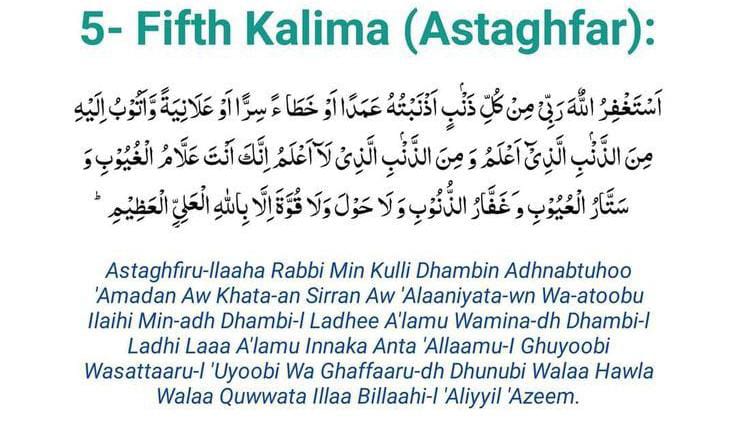
اَسْتَغْفِرُ اللّٰهَ رَبِّيْ مِنْ كُلِّ ذَنْۢبٍ اَذْنَبْتُهُ عَمَدًا اَوْ خَطَاً سِرًّا اَوْ عَلَانِيَةً وَاَتُوْبُ اِلَيْهِ مِنَ الذَّنْبِ الَّذِيْ اَعْلَمُ وَمِنَ الذَّنْبِ الَّذِيْ لَا اَعْلَمُ اِنَّكَ اَنْتَ عَلَّامُ الْغُيُوْبِ وَسَتَّارُ الْعُيُوْبِ وَغَفَّارُ الذُّنُوْبِ وَلَا حَوْلَ وَلَا قُوَّةَ اِلَّا بِاللّٰهِ الْعَلِيِّ الْعَظِيْمِ
When recited slowly, these words feel like a heartfelt plea. It expresses a believer’s humility, admitting sins whether done knowingly or unknowingly and turning back to Allah with sincerity. It declares the human weakness before the greatness of Allah and the hope in His endless forgiveness.
What makes the 5th Kalma in Arabic so meaningful is its spiritual depth. It is not just a recitation but a personal conversation with Allah, seeking His pardon and mercy. Muslims are reminded that no matter how many mistakes they make, the door of forgiveness is always open as long as they sincerely repent.
Muslims around the world recite this Kalma especially in moments of regret, after prayer, or during times of self-reflection. It strengthens the bond between a servant and the Creator by renewing the heart with purity and hope.
Just like the other Kalmas, the 5th Kalma in Arabic carries a timeless beauty. Whether written in calligraphy, memorized in schools, or whispered in the silence of the night, it reflects the believer’s reliance on Allah’s mercy.
The 5th Kalma in Arabic is more than just a supplication; it is the language of repentance, the heart of humility, and the path to Allah’s forgiveness.
5th Kalma in English
The 5th Kalma, known as Kalma Istighfar, is the declaration of seeking forgiveness. In English, it is translated as:
“I seek forgiveness from Allah, my Lord, for every sin I committed knowingly or unknowingly, openly or in secret. I turn to Him in repentance for the sins I am aware of and for those I am not aware of. Surely, You are the Knower of the unseen, the Concealer of faults, and the Forgiver of sins. There is no power and no strength except with Allah, the Most High, the Most Great.”
This powerful supplication is not just words but a heartfelt plea. It expresses human weakness, the reality of mistakes, and the hope that Allah’s mercy is greater than all sins.
For Muslims, reciting the 5th Kalma in English helps them reflect deeply on its meaning. It teaches humility, sincerity, and the importance of turning back to Allah no matter how many times one falls. Every time a believer recites it, they renew their repentance and strengthen their trust in Allah’s forgiveness.
The 5th Kalma in English also shows the universality of repentance in Islam. Whether spoken in Arabic, English, or any other language, its message remains the same: return to Allah, seek His pardon, and live with hope in His mercy.
5th Kalma Translation in Urdu
ترجمہ:
میں اللہ سے، جو میرا رب ہے، اپنے سب گناہوں کی معافی مانگتا ہوں جو میں نے جان بوجھ کر یا بھول کر، چھپ کر یا ظاہر ہو کر کیے۔ میں اس سے ان گناہوں کی بھی معافی چاہتا ہوں جنہیں میں جانتا ہوں اور ان کی بھی جنہیں میں نہیں جانتا۔ بے شک تو ہی غیب کا جاننے والا ہے، عیبوں کو چھپانے والا ہے اور گناہوں کو بخشنے والا ہے۔ اور کوئی طاقت اور قوت نہیں مگر اللہ کی، جو بلند اور عظیم ہے۔
This Urdu translation shows that the 5th Kalma (Kalma Istighfar) is a prayer of repentance. The believer asks Allah for forgiveness for all sins those done knowingly or unknowingly, secretly or openly. It also covers sins that one remembers and those forgotten.
The Kalma reminds Muslims that Allah is All-Knowing, He conceals faults, and He is the Forgiver of sins. It ends with the reminder that true power and strength come only from Allah, the Most High and the Most Great.
By reciting this Kalma, Muslims express humility, admit their mistakes, and return to Allah with hope in His endless mercy.
Meaning of the 5th Kalma
The 5th Kalma is about seeking forgiveness from Allah.
A believer asks Allah to hide faults and pardon them.
It teaches that only Allah can forgive and protect.
This Kalma reminds Muslims that repentance brings mercy.
It gives peace to the heart and removes despair.
It also encourages humility and constant self-reflection.
By reciting it, Muslims strengthen their bond with Allah.
5th Kalma in the Quran and Islam
The 5th Kalma, known as Kalma Istighfar, is a prayer of repentance. Although the Kalmas themselves are not directly written in the Quran as a set, their meanings are deeply rooted in Quranic teachings. The Holy Quran repeatedly emphasizes Istighfar (seeking forgiveness) as an important act of worship. Allah says in the Quran:
“And ask forgiveness of Allah. Indeed, Allah is ever Forgiving and Merciful.”
(Surah An-Nisa 4:106)
This shows that seeking forgiveness is not only a recommended act but also a command from Allah. The 5th Kalma captures this command in the form of a heartfelt supplication.
Repentance in Islamic Teachings
Islam teaches that no human is free from mistakes. However, the door of repentance is always open. The Prophet Muhammad (peace be upon him) said:
“Every son of Adam sins, and the best of those who sin are the ones who repent.”
(Sunan Ibn Majah 4251)
This hadith highlights the value of repentance, which is the essence of the 5th Kalma. It encourages Muslims to admit their shortcomings and seek Allah’s mercy.
Importance of Seeking Forgiveness
In Islam, asking Allah for forgiveness purifies the heart. It removes the burden of sins and brings a believer closer to Allah. Reciting the 5th Kalma reminds Muslims that Allah is the Concealer of faults and the Forgiver of sins. It brings hope, peace, and spiritual strength to continue on the path of faith.
When to Recite Kalma 5th
Muslims can recite the 5th Kalma at any time, because seeking forgiveness is always needed. However, some special moments make it even more meaningful:
- After Salah (prayers): Reciting the 5th Kalma after daily prayers helps a believer seek forgiveness for any shortcomings in worship.
- During Tahajjud or night prayers: The quiet of the night is a powerful time to repent and connect with Allah.
- When feeling guilty or regretful: Whenever a Muslim realizes they have sinned, reciting this Kalma with sincerity brings peace.
- In times of hardship: Seeking Allah’s pardon during trials opens doors of mercy and relief.
- Before sleeping: Saying the 5th Kalma at night cleanses the heart and soul before resting.
- On Fridays and special days: Reciting it more often on blessed days increases rewards and forgiveness.
The 5th Kalma is not limited to a fixed time. It is a reminder that turning back to Allah is always open, no matter the situation or place.
Importance of the 5th Kalma
The 5th Kalma holds deep spiritual value in Islam. It is called Kalma Istighfar, which means the declaration of seeking forgiveness. Its importance comes from the fact that every human makes mistakes, but Allah’s mercy is greater than all sins.
- Strengthens the bond with Allah: By admitting sins and seeking pardon, a believer grows closer to their Creator.
- Cleanses the heart and soul: Reciting this Kalma purifies the inner self from guilt and spiritual burdens.
- Teaches humility: It reminds Muslims that they are weak and always in need of Allah’s help and mercy.
- Opens the doors of mercy: The Quran says that Allah loves those who repent sincerely, and this Kalma is a reflection of that repentance.
- Brings peace and hope: It replaces despair with hope, showing that no matter how many mistakes a person makes, Allah forgives when one turns back to Him.
In short, the importance of the 5th Kalma lies in its power to renew faith, bring comfort to the heart, and connect a Muslim to Allah’s endless mercy.
Benefits of the 5th Kalma
Reciting the 5th Kalma brings many spiritual and emotional benefits for a believer. Some of the key benefits include:
- Forgiveness of sins: It helps Muslims seek pardon for mistakes done knowingly or unknowingly.
- Peace of heart: Saying it with sincerity removes guilt and brings inner calm.
- Spiritual cleansing: It purifies the soul from sins and wrongdoings.
- Hope in Allah’s mercy: It reminds believers that Allah’s forgiveness is greater than their sins.
- Strength against despair: It gives courage to move forward instead of being trapped by regret.
- Closer relationship with Allah: Constantly seeking forgiveness builds a stronger bond with the Creator.
- Protection from arrogance: Admitting faults keeps the heart humble.
The 5th Kalma is more than words it is a doorway to mercy, hope, and a renewed connection with Allah.
Final Thoughts
The 5th Kalma, also known as Kalma Istighfar, carries a timeless message of mercy, humility, and hope. It reminds believers that no matter how many mistakes they make, Allah’s door of forgiveness is always open. Reciting it with sincerity strengthens faith, cleanses the heart, and brings peace to the soul. For Muslims, this Kalma is a daily reminder that human weakness is natural, but Allah’s mercy is far greater than any sin.
In Islam, turning back to Allah through repentance is considered a sign of true devotion and sincerity. The 5th Kalma captures this act of repentance beautifully, teaching believers to admit their shortcomings, avoid arrogance, and seek Allah’s endless mercy. It is not just a set of words but a spiritual practice that helps Muslims remain humble, conscious of their actions, and hopeful for Allah’s pardon.
By reciting this Kalma regularly, a believer renews their spiritual connection and strengthens their inner resolve to live according to Islamic teachings. It encourages self reflection, brings comfort during times of guilt, and inspires hope even after repeated mistakes. More importantly, it emphasizes that seeking forgiveness is not a weakness, but a path to becoming closer to Allah, the Most Forgiving and the Most Merciful.
👉 Strengthen your faith with guided learning join our Online Quran Classes and book a free trial today.
Explore:
- Online Quran Classes
- Tajweed Course
- Quran for Beginners
- Free Trial / Contact Us